About the Author
From the Castle to the Cotton Mill comes from inside the history it tells.
When the Supreme Court overturned Roe v. Wade in 2022, I went into my backyard, set a pile of pinecones on fire, and cried out in rage. What followed was not only grief — it was a question I couldn't shake: Why do so many women, especially white Southern women, not yet see what is being taken from them? How did we get here?
I looked back a thousand years through my own maternal line and saw that the forces trying to take us backward were not new — and silence was no longer an option.
I am descended from every woman in this book. These women are my grandmothers, and their silences shaped the women who raised me. I wrote from inside that inheritance.
When I looked back through my maternal line, I saw a system that exploited and marginalized women through violence, religion, law, and culture, and most of all through psychological control. Patriarchy doesn't live only in laws and institutions. It colonizes the mind.
The language is always the same: Be good. Be small. Be grateful. Be sweet.
This is not a genealogy book. It is not an academic history. It is not a trauma memoir. It is my attempt to trace the interior life of women across ten centuries, and to find, in that tracing, something that loosens the grip.
I worked first as a journalist and then as an English teacher for decades, but I have never been interested in reading history as a catalog of battles and conquests. I wanted to read about the women: what they endured, what they believed about themselves, and how those beliefs moved through generations. I wrote the book I wanted to read, and I hope you do, too.
I was raised in Alabama's cotton-mill culture — the granddaughter of a woman who got on a bus in 1945 and left the man who beat her, and the sixteen-times great-granddaughter of the Queen of Scots who had no such option.
A first-generation college graduate, I earned a master's degree in English and spent my career teaching writing and literature at both the college and high school levels, including a decade at schools in Fayette County, Georgia — the same county where my ancestor Nancy Whaley was born, lived, and is buried in an unmarked grave. I didn't know that history when I moved here in 2011. I do now, and it changed everything about how I read this place.
My training as a journalist never left me. I am drawn to the documented fact, the named woman, the story that can be verified and still breaks your heart.
My husband Bill and I have stood together at the Bayeux Tapestry, at Balvenie Castle, at Holyrood Abbey, and at the Legacy Museum in Montgomery. He has never once rushed me. When I need to stand at a monument until the light disappears, he waits. That is not a small thing.
For a woman writing a book about what a thousand years of women were denied, being chosen by someone who makes room for your obsessions — that turns out to be part of the story, too.
I wrote this book to braid us all together — to keep these women from disappearing and to break the pattern that made them.
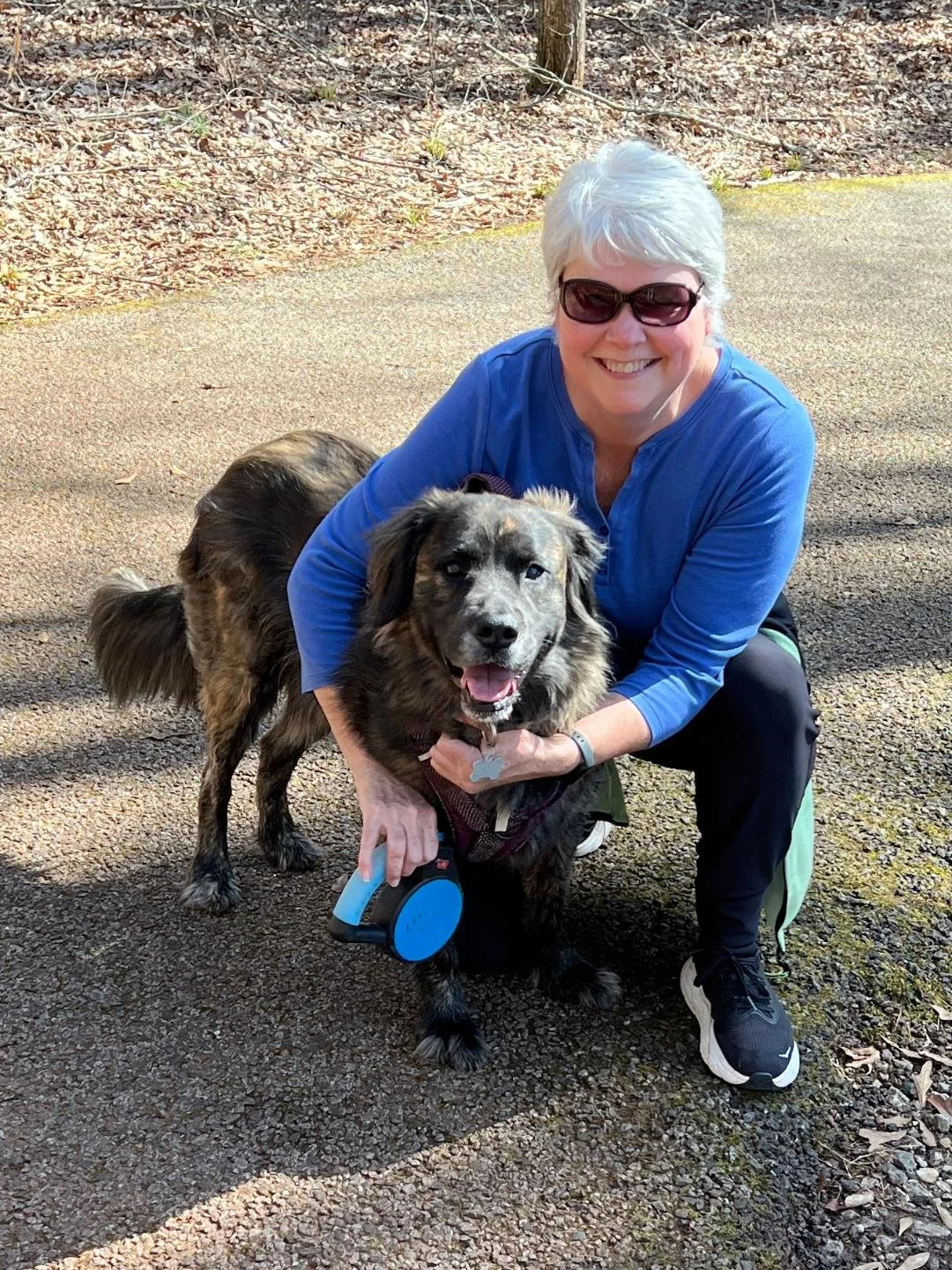
The author with her fur-baby Levi
Contact me
I welcome messages from readers, book clubs, event organizers, librarians, educators, and anyone whose grandmothers and women’s rights are on their mind.
Use the form here to reach me — I read everything and respond personally.