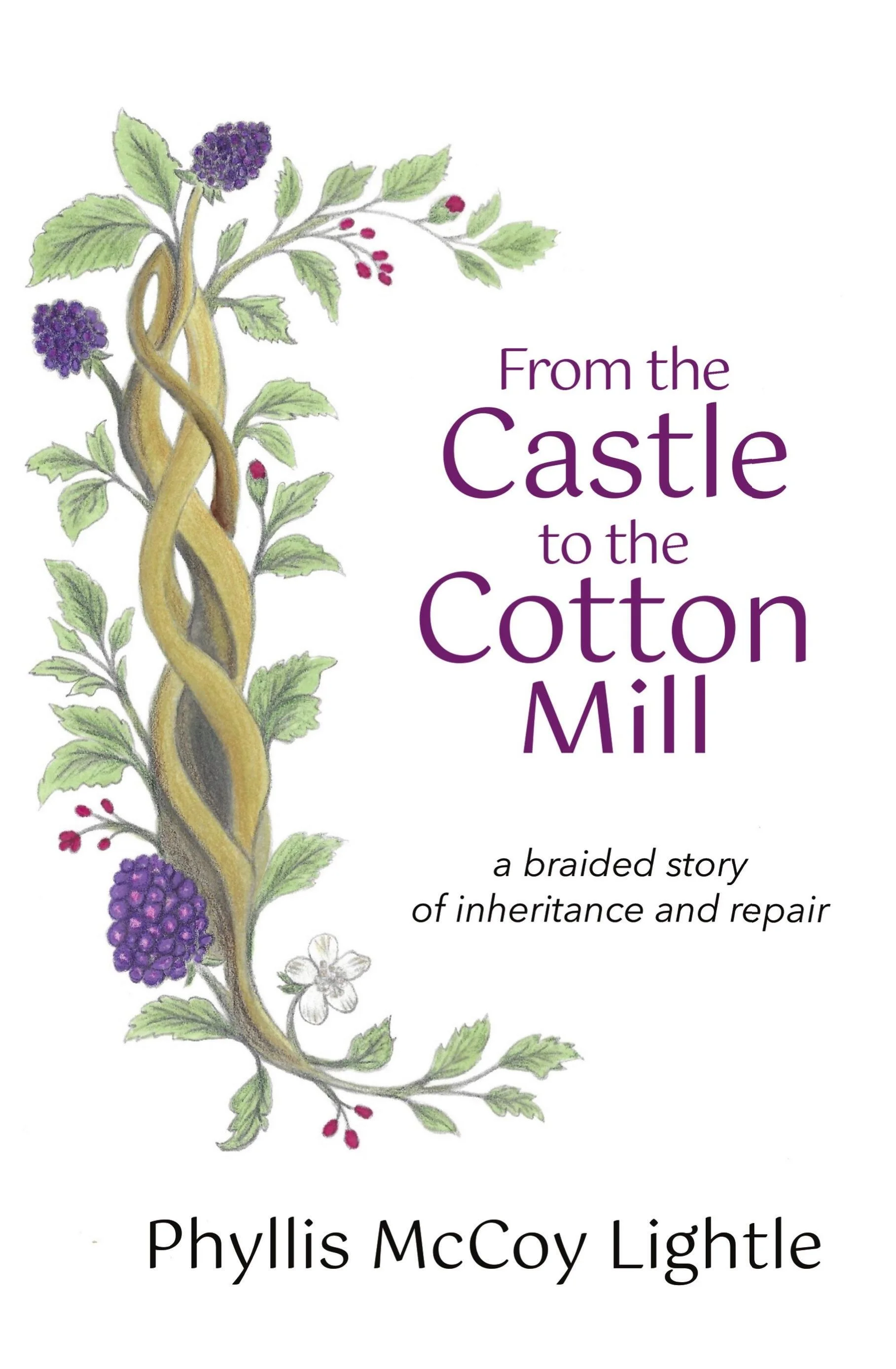
From the Castle to the Cotton Mill
A Braided Story of Inheritance and Repair
by Phyllis McCoy Lightle
“The Dobbs decision didn’t set us back fifty years.
It awakened everything we’ve been carrying since the Dark Ages.”
—From the Castle to the Cotton Mill
My grandmother got on a bus in 1945 and left the man who beat her. Her line traces back to medieval queens who had no such option. From the Castle to the Cotton Mill follows that maternal line across nearly a thousand years — through Scottish nobility, colonial Quakers, and Alabama cotton mills — to my own divorce, recovery, and reckoning with the Dobbs v. Jackson decision. This book asks what women inherited across those centuries, and what it finally takes to break the pattern.
This is not a genealogy book.
It is a book about psychological inheritance — the beliefs women absorb about their own worth, their bodies, their right to speak, their right to leave or to lead. It is about how those beliefs are passed down.
The form of this book is the braid.
Each set of chapters interweaves three generations — a grandmother, her daughter or daughter-in-law, and her granddaughter. It follows one line as a method of psychological excavation. The braid applies to these women’s stories because they cannot be separated from each other or from the present moment.
This book is for readers of women’s history who want the personal alongside the political,
for those recovering from patriarchal religion who are looking for a different kind of spiritual language, and
for those who love the American South without sentimentality.
If you are angry that women’s rights are being taken in parts of America, this book provides a thousand years of context.
You may come away asking new questions about your own mother and grandmothers: What did she believe about herself? Where did that belief come from? What did it cost her? And what did they pass to us without any of us knowing?